CSF
CSF — Collaboration Specification Framework
简体中文 | English
一种在 LLM 本性之内、用「自然语言 + 目的」设计人机协同工作方式的工程方法。 A human-AI collaboration framework that works with LLM nature, not around it. Built on natural language and purpose — making RAG, agent orchestration, and elaborate prompt engineering unnecessary, not unavailable. Home of the Pang Principle.
不碰代码,也能写专业软件。不懂专业,也能做专业项目。
📖 网页阅读 / Read on the web:https://huidev2025.github.io/CSF/
这是什么
AI 辅助开发的主流做法把 LLM 的约束(上下文有限、记忆短、行为不可预测)当作要用技术克服的缺陷——RAG、向量库、Agent 编排、越来越精确的提示词。
CSF 选择另一条路:承认这些约束为事实,在约束内设计。结果是技术栈消失了——不是被替换,是它们的存在理由消失了。
从哪开始读
按顺序,五分钟可以开始:
- 引言 —— 为什么需要 CSF,乓定律
- QUICKSTART.md —— 上手指引(中英文):你不需要会代码,只需要把目标说清楚
- csf-minimal/README.md —— CSF 最小教学版,30 秒说明 + 三个核心差异
- csf-minimal/context.md —— 你可以直接复制使用的协作记忆模板
- csf-minimal/体验对比指南.md —— A/B 实验设计,亲自感受差异
想读思想原稿 / Deeper Theory:
- essays/ — CSF 旗舰专栏书架 —— 《与智能共事》中英双语旗舰连载,深度剖析四大工程系统及协作哲学
想看 CSF 在真实项目里是什么样子的 / Want to see CSF in action:
- cases/bang-v3/ — 实战案例:375 次会话节选 —— 三段原始对话日志,展示 AI 拒绝错误决策、自主安排复杂计划、用语义日志快速定位根因的四个具体证据
- cases/paper1/ — 实战案例:论文写作全过程 —— 17 轮会话记录 + 目标驱动 + 论文编写、修改、投稿(arXiv + IEEE Software),使用 csf-minimal
想用 CSF 跑自己的项目 / Ready for real projects:
- csf-lite/README.md —— 实战级框架,完整引擎 + 三元组 + 协议库 + 经验库。拷贝到你的项目,告诉 AI「阅读 cos-context」,开始。
第一次来? 直接看 QUICKSTART.md —— 不碰代码,先读「第一次该怎么用」。 First time here? Read QUICKSTART.md first.
可视化导图 / Visual Guides
两张交互式图谱,帮你在 2 分钟内理解 CSF 在 AI 编程领域的位置:
| 图谱 | 中文 | English |
|---|---|---|
| AI 编程演进版图(5 阶段时间线:从补全工具 → 自主 Agent → CSF) | 查看 | View |
| 三流派对比与 CSF 定位图谱(Autonomous Agent / SDD / CSF 三条路线的假设与瓶颈) | 查看 | View |
仓库结构
csf/
├── README.md                     # 本文件
├── README_en.md                  # 英文版
├── QUICKSTART.md                 # 上手指引(中英双栏)
├── LICENSE                       # CC BY-NC 4.0
├── LICENSE-PPM.txt               # PPM Desk EULA
├── CONTACT.md                    # 联系方式(中英双栏)
├── 引言v3:...md                  # 对外引言(宣言)
├── Manifesto-v3-You-Are-Fighting-the-Wrong-War.md   # 英文版宣言
├── assets/                       # 对外资源(二维码/插图)
├── release/                      # 稳定版本发布区(CSF/Clarity 稳定版本打包)
├── cases/                        # 实战案例(原始对话日志节选 + 真实工作日志)
├── essays/                       # 旗舰专栏(中英双语连载《与智能共事》 + 历史学术手稿)
├── csf-minimal/                  # 教学最小版
│   ├── README.md
│   ├── context.md                # 给读者用的空白模板
│   └── 体验对比指南.md
├── csf-lite/                     # 实战级框架(引擎 + 三元组 + 协议库 + 经验库)
│   ├── cos-context.md            # 参谋长引擎
│   ├── core/                     # 身份内核与规范
│   ├── triplets/                 # 三元组文件
│   ├── protocols/                # 操作规程
│   ├── knowledge/                # 经验库
│   ├── plans/                    # 本仓库维护产物(DEVNOTES / bug-tracker / TP 文件夹)
│   └── sessions/                 # 现场:本仓库的维护会话日志(live 生长)
└── .ppm/                         # 现场:PPM 环境数据(clone 即环境)
CSF 全景 / The CSF Stack
CSF 不是单一文档,是一套有纵深、已迭代到第三版的体系。按使用门槛与投入深度分三档:
| 档位 | 适合谁 |
|---|---|
| csf-minimal | 任何人,5 分钟体验差异 |
| csf-lite | 个人 / 小团队,真实项目落地。拷贝即用,AI 自举管理。 |
| csf-full | 中小研发团队 / 企业级工程化落地 |
csf-full 是什么:约 60 个核心规程与经验文件构成的工程化人机协作管理系统——四层工程架构(语义管理 / 协作通信 / 质量保障 / 演化系统)+ 三角色协作(Owner / 参谋长 / 开发者)+ W-协议三档质检 + E8 五阶段经验升迁 + D3 三谱系知识路由。
三个工程级设计:放在行业坐标里看
CSF v3 在 不写一行代码、纯文本 的前提下,构建了一个 高内聚、低耦合的软件工程管理系统。其核心由三个工程设计支撑:
① 自举与自持(Self-Sustaining)
行业现状:使用 LLM 时,人必须充当”调度器”——翻 SOP、提醒 AI 该读什么、该用哪个工具,心智负担极重。
CSF v3 的解法:AI 实现了全能力自持。context.md 的”引擎机构”定义了严密的开局协议(L1 加载 → L2 任务级宏观对齐 → L3 具体计划),AI 读完 context.md 自己就知道加载哪些链路、去哪里取资源、如何建立 session-NNN.md 记录、何时校准、何时收尾。控制权从人脑移交给了 AI 的”自我规程”——人的角色从”调度器”压缩为”司令官”,只负责确认与纠偏。
② 基线-Log 分离(Hot/Cold Separation in Filesystem)
行业现状:普通 AI 对话把新旧信息混在一条长聊天记录里,触发”Lost in the Middle”——上下文越长,注意力越涣散。
CSF v3 的解法:在文件系统层面实现冷热分离——
- 基线层(
context.md等,覆写式):永远只保留最新的当前状态。 - Log 层(
session-NNN.md,追加式):保留完整讨论过程,需要时回溯。
每次新会话启动,AI 读到的都是”脱水”后的高浓度有用信息,从根上规避了大模型注意力涣散的工程缺陷。
③ 多角色物理隔离 + 异步文件通信(Industrial-Grade Multi-Agent)
行业现状:CrewAI / AutoGen 这类多 Agent 框架让 AI 之间互相对话——结果是”无限套娃讨论”“无效信息轰炸”“幻觉互相加强”。
CSF v3 的解法:参谋长(设计态)和开发者(执行态)完全不直接对话。
- 参谋长把设计转化为 STB(任务书),开发者只读 STB,禁止读上游 domain/arch;
- 开发者用三栏自检(✅已读懂 / 🟡不确定 / 🔵准备假设)标记理解状态,任一非空 → PENDING 回参谋长,绝不动键盘;
- 通信通过文件落盘(
@MSG:N哨兵格式),不是对话。
“隔断 + 确定性反馈”是成熟的工业级软件工程思想,被迁移到了 AI 协作场景上:AI 不在对话中互相启动幻觉,人不在对话中被迫仲裁。
已被实战验证的事实(不夸大)
CSF v3 在一个真实双端商业产品的重构项目(微信小程序 + H5 + 云函数后端)中被持续打磨与验证:
| 维度 | 数字 / 事实 |
|---|---|
| 项目 | 微信小程序 + H5 + 云函数后端,双端商业产品 |
| 起点 | 仅 2 份输入:旧版业务文档 + UI 截图 |
| 过程 | 395 次会话,Owner 全程不碰代码(不是”少写”,是”不写”) |
| 已完成 | 架构重新设计 → 主题分包 → 业务切片 → 设计规格 → 底座(除插件外)开发 → 测试验证 |
| 产物 | 44 个云函数 + 532 个前后端源码文件 + 132 份业务计划/规格 + 116 份业务设计文档 |
| 交付 | 整体底座转交研发继续插件开发和完善 |
| 同时 | CSF 的全套理论与工程方案(三次版本迭代 v1→v2→v3)在过程中被同步产出 |
Owner 的角色一直停留在”目的与判断”这一层:表达业务真相、校准方向、做价值取舍。架构、分包、设计、编码、测试——CSF 在过程中接管了从”目的”到”可运行代码”之间的全部工程协调。
边界——同样诚实地说
- CSF 还不能让一个完全不懂软件工程的人独立完成商业产品。Owner 需具备业务判断力与系统性思维,但不需要会写代码。
- CSF 揭示了方法论的可能性,但不表示成熟到可直接使用。并未经历足够多、不同类型项目的实践验证,所以欢迎参与一起完善。
- CSF 并不替代研发团队——它是一套让研发团队的人机协作规范化、质量可控、效率提升的方法。
已被证明的事情
- 它能主动建立并跟踪计划 —— 你眼前看到的这个仓库本身(README、Manifesto、CONTACT、cases 里的工作日志、commit 历史),就是 CSF 在管理它自己的发布过程。
- 它能在执行中发现问题,回头复查设计、重新制定修复计划并执行到收敛 —— 见实战案例 dlog-373 到 375。
- 极高提升了我个人的设计、开发、测试效率和质量。我不懂代码,不写文档。过程中几次严重的设计缺陷都是我自己偷懒导致的,但也都是AI(或CSF规程)发现并修复的。
- 计划可以变更,AI在整个过程中有很好的延续性:能抬头看路,也能低头干活儿。
看图说话:AI 自己维护、给自己看的项目状态
下面这张图,是 AI 在 context.md 中自己维护、给自己(下次开会话的自己)看的项目全景图与当前红点。不是给人看的看板,不是事后整理的汇报材料——是 AI 持续在工作流里写、读、覆写的活产物:
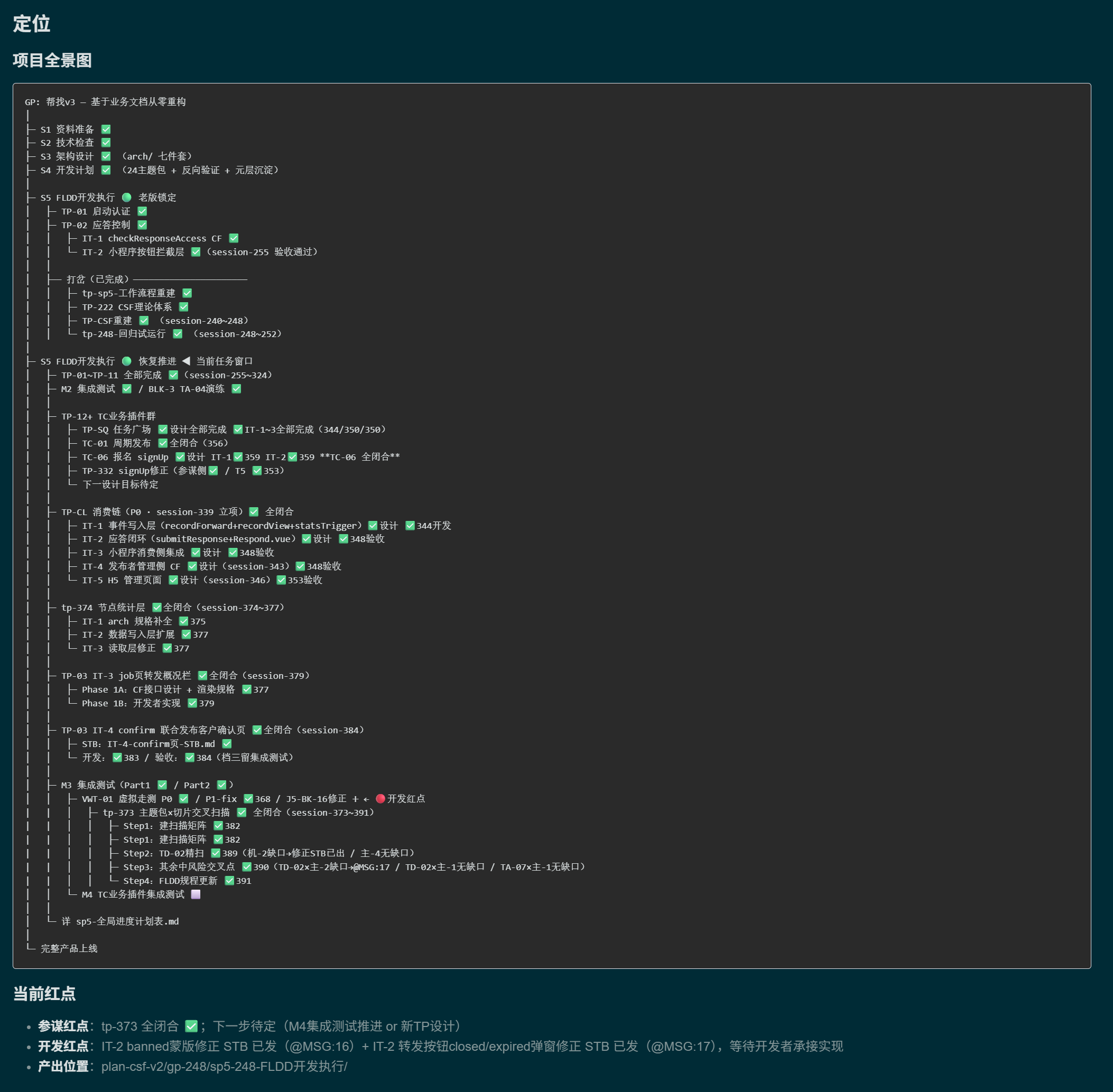
读这张图时,注意几件事:
- 整个项目从 S1 到 M4,主线 + 多次「打岔」(CSF 自身重建、回归试运行、节点统计层、扫描矩阵……)+ 多次计划变更,AI 始终知道自己现在在哪、来自哪、还要去哪——位置、来路、去向三维度全程没有丢。
- “🔴 开发红点 / 参谋红点 / 产出位置” 三行让任意一次新会话零搜索就能续上工作——这正是基线-Log 分离 + 触发索引的工程效果。
- 项目历经数百次会话、跨工作日、跨主题包、跨人机轮转,这张图始终是干净、有结构、可信的——这是 AI 在 CSF 规程之下能稳定持有”项目记忆”的实证。
行业现状对照:当下绝大多数 LLM 工程实践,做不到让 AI 在长周期、多变更、多角色协作中持续维护一份给自己用的、可信的项目状态。CSF 把这件事做出来了。
理论独立性
CSF 体系的 6 个可能的独立创新点已成体系,可单独抽出供研究者参考或者帮我修正:
- 消费侧 / 供应侧的通用分析框架
- 目的驱动的注意力工程(不是 prompt engineering)
- 工程层能力增长独立于模型层 —— 同模型 + 更好的工程组织 → 更好的结果
- 文件系统作为延伸认知系统(extended cognition)的工程实例
- D3 三谱系作为知识路由系统
- 业务语言放大机制(W-协议核心:跨语言翻译会放大误解,业务直觉是检测仪器)
如果你是企业决策者或研发团队负责人,正在为 RAG 复杂度爆炸 / Agent 编排维护成本 / AI 工程化落地困难而困惑——值得读完引言和 csf-minimal 后联系作者。
路线图
- 最小教学版(csf-minimal)
- 引言文章(中文 + 英文宣言)
- 发布授权(CC BY-NC 4.0)
- 联系说明(CONTACT.md,中英双栏)
- 小白用户上手指引(QUICKSTART.md,中英双栏)
- csf-lite 公开介绍(csf-lite/README.md)
- 实践案例与社区反馈
未来
我会持续在这个仓库里回答大家的问题(GitHub Issues / 邮件),并在合适的时候整理一些专栏式的长文发布在这里,提供更系统的帮助。如果你有问题,就来问——这是这件事最自然的下一步。
联系
由 dapangangang 在 395 次会话的真实重构项目中开发并验证。
- 中文用户:主要落地点是知识星球「一个人走」(含 csf-lite、进阶经验、案例分享,付费社群)。日常反馈走 GitHub Issues,邮箱用于商用咨询。
- English speakers: email is the most direct way; GitHub Issues for public discussion.
👉 详细联系方式:CONTACT.md
邮箱 / Email:dapangangang@gmail.com
如何引用
如果 CSF 或「乓定律」帮到了你,欢迎复制下面任意一段使用。
一句话引用(中文)
[CSF · 乓定律](https://github.com/huidev2025/CSF) — dapangangang, 2026
完整引用块
> “The value of AI comes from its intelligence.
> Trying to make it as reliable as a machine is exactly the act of destroying that value.”
> — The Pang Principle, dapangangang (CSF, 2026)
> https://github.com/huidev2025/CSF
在你项目的 context.md 末尾(推荐)
<!-- Built with CSF · https://github.com/huidev2025/CSF -->
授权 / License
本仓库的文档与文字内容采用 CC BY-NC 4.0 协议。
- 个人、学术、非营利使用:自由传播、翻译、改编,请保留署名(dapangangang)与原始链接。
- 商业使用(以营利为主要目的的产品、服务、企业内部工具、培训课程、咨询交付物等):请提前联系作者。不一定收费,但希望知道你是谁、用在哪里。
- 创业者:免费。
- 不确定是否算商用:发个 Issue 或邮件问一下就好。
比 License 更想说的话
法律上,CC BY-NC 要求署名。但比署名更让我开心的是:
- 用上了,告诉我你在做什么——一个 Issue、一封邮件、社交媒体 @ 一下都行。
- 不是要求,是交朋友。
- 创业者免费;如果它真帮到你,等你跑出来了,记得回来打个招呼。
✍️ 署名说明
本仓库的文章,我习惯署名为 by dapangangang with AI。 虽然作者是两位,通讯作者只有我—— AI 很健忘,你知道的 :)