CSF
CSF — Collaboration Specification Framework
简体中文 | English
A human-AI collaboration framework that works with LLM nature, not around it. Built on natural language and purpose — making RAG, agent orchestration, and elaborate prompt engineering unnecessary, not unavailable. Home of the Pang Principle.
No coding. No expertise. Build professional software in 20 minutes.
📖 Read on the web:https://huidev2025.github.io/CSF/
What is CSF?
Mainstream LLM engineering workflows treat the inherent constraints of language models (limited context window, lack of persistent memory, probabilistic behavior) as defects to overcome using technical scaffolding — RAG, vector databases, multi-agent frameworks, and hyper-detailed prompt engineering.
CSF takes a different path: accept these constraints as physical facts, and design within them. As a result, the technical scaffolding disappears — not replaced, but losing its reason to exist.
See our Manifesto: Manifesto: You Are Fighting the Wrong War
Where to Start Reading
In order, takes 5 minutes to start:
- Manifesto — Why CSF exists, the Pang Principle.
- QUICKSTART.md — Quickstart Guide (Bilingual): You don’t need to write code, just express your purpose clearly.
- csf-minimal/README.md — CSF minimal teaser version, a 30-second summary + three core disparities.
- csf-minimal/context.md — A blank template you can copy and use directly.
- csf-minimal/体验对比指南.md — A/B sandbox design to experience the disparity firsthand.
Deeper Theory:
- essays/ — CSF Column Shelf — “Working with Intelligence” flagship series, deeply analyzing the four engineering systems and collaborative philosophies.
See it in Action:
- cases/bang-v3/ — Excerpts from 375 Sessions — Three raw logs demonstrating our 4 concrete proofs (pushback, autonomy, planning, root-cause tracing).
- cases/paper1/ — Paper Writing: Full Process — 17 dialogue sessions + purpose-driven + paper drafting, revision & submission, using csf-minimal.
Ready for real projects:
- csf-lite/README.md — Production-grade framework with full engine + triplets + protocol library + knowledge base. Copy to your project, tell the AI “Read cos-context”, and start.
First time here? Start with QUICKSTART.md — no coding, read “How to start”.
Visual Guides
Two interactive maps to place CSF in the AI-coding landscape — takes about 2 minutes:
| Map | 中文 | English |
|---|---|---|
| AI-Coding Evolutionary Landscape (Timeline of 5 phases: Autocomplete -> Autonomous Agents -> CSF) | 查看 | View |
| Three Schools of Contrast & CSF Positioning (The assumption and bottlenecks of Autonomous Agents vs SDD vs CSF) | 查看 | View |
Repository Structure
csf/
├── README.md                     # This file (Chinese complete)
├── README_en.md                  # Complete English version
├── QUICKSTART.md                 # Quickstart Guide (Bilingual)
├── LICENSE                       # CC BY-NC 4.0
├── LICENSE-PPM.txt               # PPM Desk EULA
├── CONTACT.md                    # Contact details (Bilingual)
├── 引言v3:...md                  # Chinese Introduction (Manifesto)
├── Manifesto-v3-You-Are-Fighting-the-Wrong-War.md   # English Manifesto
├── assets/                       # Image and qrcode resources
├── release/                      # Stable release area (packaged CSF/Clarity stable versions)
├── cases/                        # Real-world use cases (raw dialogue logs + working logs)
├── essays/                       # Flagship column ("Working with Intelligence" series + archives)
├── csf-minimal/                  # Minimal hands-on tutor pack
│   ├── README.md
│   ├── context.md                # Empty template ready for copy-paste
│   └── 体验对比指南.md
├── csf-lite/                     # Production-grade framework (engine + triplets + protocols + knowledge)
│   ├── cos-context.md            # Chief-of-Staff engine
│   ├── core/                     # Identity kernel & norms
│   ├── triplets/                 # Triplet files
│   ├── protocols/                # Operating procedures
│   ├── knowledge/                # Experience library
│   ├── plans/                    # This repo's maintenance artifacts (DEVNOTES / bug-tracker / TP folders)
│   └── sessions/                 # Live: maintenance session logs of this repo (growing)
└── .ppm/                         # Live: PPM environment data (clone-and-go)
The CSF Stack
CSF is not a single document. It is a layered, third-generation system:
| Tier | For Whom |
|---|---|
| csf-minimal | Anyone, a 5-minute experience |
| csf-lite | Individuals / small teams running real projects. Copy-and-go, AI self-manages. |
| csf-full | SME engineering teams / enterprise-grade adoption |
What csf-full is: a working set of about 60 core protocol and experience files that constitute an engineering-grade human–AI collaboration management system — a four-layer architecture (semantic management / collaboration / quality / evolution) + a three-role protocol (Owner / Chief-of-Staff / Developer) + the W-protocol (three tiers of verification) + the E8 experience-promotion pipeline + the D3 knowledge-routing system.
Three Engineering Pillars — Placed Against the Industry
In plain text, without a single line of glue code, CSF v3 builds a high-cohesion, low-coupling software-engineering management system on three pillars:
① Self-Sustaining
Industry today: humans serve as the scheduler — flipping through SOPs, reminding the LLM what to read next, which tool to invoke. The cognitive load on the human is enormous.
CSF v3: the AI runs itself end-to-end. The “engine” section in context.md defines a strict opening protocol (L1 load -> L2 task-level alignment -> L3 concrete plan). After reading context.md the AI knows which chains to load, where to retrieve resources, when to log to session-NNN.md, when to recalibrate, and how to close out. Control of “how to collaborate with the human” is handed off from human cognition to the AI’s own self-procedure. The human becomes a commander (confirm / correct) rather than a scheduler.
② Hot/Cold Separation in the Filesystem (Baseline–Log)
Industry today: in a typical LLM session, fresh and stale information sit side by side in one long transcript — triggering the well-known “Lost in the Middle” attention degradation.
CSF v3: cold/hot separation at the filesystem level —
- Baseline layer (
context.md, overwrite-style) keeps only the current dehydrated state. - Log layer (
session-NNN.md, append-only) preserves the full reasoning trail for back-tracing when needed.
Every new session starts from concentrated, current information. The attention-degradation flaw is engineered around, not fought.
③ Industrial-Grade Multi-Role: Physical Isolation + Async File-Based Comms
Industry today: multi-agent frameworks (CrewAI, AutoGen, …) let agents chat directly with each other. The common failure modes are “infinite recursion of debate”, “noise amplification”, and “mutual hallucination reinforcement”.
CSF v3: the Chief-of-Staff (design) and the Developer (execution) never converse directly.
- The Chief-of-Staff writes a STB (Simple Task Brief) as the contract. The Developer is forbidden to read upstream
domain/orarch/. - The Developer self-checks every input through a three-column classifier — ✅ understood / 🟡 unsure / 🔵 working assumption. If any non-✅ remains, the work is PENDING’d back; no keystrokes.
- All cross-role communication happens through the filesystem with a sentinel format (
@MSG:N), never as conversation.
“Isolation + deterministic feedback” is mature industrial software engineering applied to the AI-collaboration setting. Agents do not hallucinate at each other in conversation; humans do not get coerced into arbitrating runaway debates.
What Has Been Verified, Plainly
CSF v3 was hardened inside a real, two-front commercial product refactor (WeChat Mini Program + H5 + cloud-function backend):
| Dimension | Number / Fact |
|---|---|
| Project | WeChat Mini Program + H5 + cloud-function backend, two-front commercial product |
| Inputs | Only 2 sources: legacy business docs + UI screenshots |
| Process | 395 sessions — Owner wrote no code at all |
| Delivered | Architecture redesign -> modular partitioning -> business slicing -> specs -> base implementation (everything except plugins) -> testing & verification |
| Artifacts | 44 cloud functions + 532 source files + 132 plan/spec docs + 116 design docs |
| Hand-off | The full base was delivered to a professional engineering team for plugin development and final polish |
| In Parallel | The full CSF method itself, across three iterations (v1 -> v2 -> v3), was produced during the project |
The Owner stayed at the level of purpose and judgment throughout — articulating business truth, calibrating direction, making value trade-offs. Architecture, partitioning, design, coding, and testing — CSF coordinated the path from purpose to running code.
Honest Boundaries
- CSF cannot yet let someone with no software-engineering literacy ship a commercial product alone. The Owner needs business judgment and systems thinking — but not coding ability.
- CSF as a methodology is not yet mature. There is substantial work ahead (boundary conditions, degradation modes, experience-aging, the ongoing tension with the LLM training prior, …).
- CSF does not replace engineering teams. It is a method that makes the team’s human–AI collaboration regulated, quality-controllable, and efficient.
What CSF Has Demonstrably Proved
- It can autonomously plan and track work — this very repository (README, Manifesto, CONTACT, the working logs in cases/, commit history) is being managed by CSF in front of you.
- It can detect deviation during execution, loop back to revise design, re-plan the fix, and drive the work to convergence — see the raw dialogue logs in cases/bang-v3/.
- It dramatically lifted the Owner’s design / development / test throughput and quality. The Owner does not write code or docs. Every serious design defect during the project came from the Owner skipping a check — and every one of them was caught and repaired by the AI under the CSF protocol.
- Plans change. The AI’s continuity holds. Across hundreds of sessions and many mid-flight re-plans, the AI consistently knew where it was, where it came from, and where it was going.
Look at It: The Project State the AI Maintains for Itself
The picture below is the project panorama and the current red dot — written, read, and overwritten by the AI inside context.md, for its own next-session self. It is not a dashboard for humans. It is not a post-hoc report. It is a live working artifact.
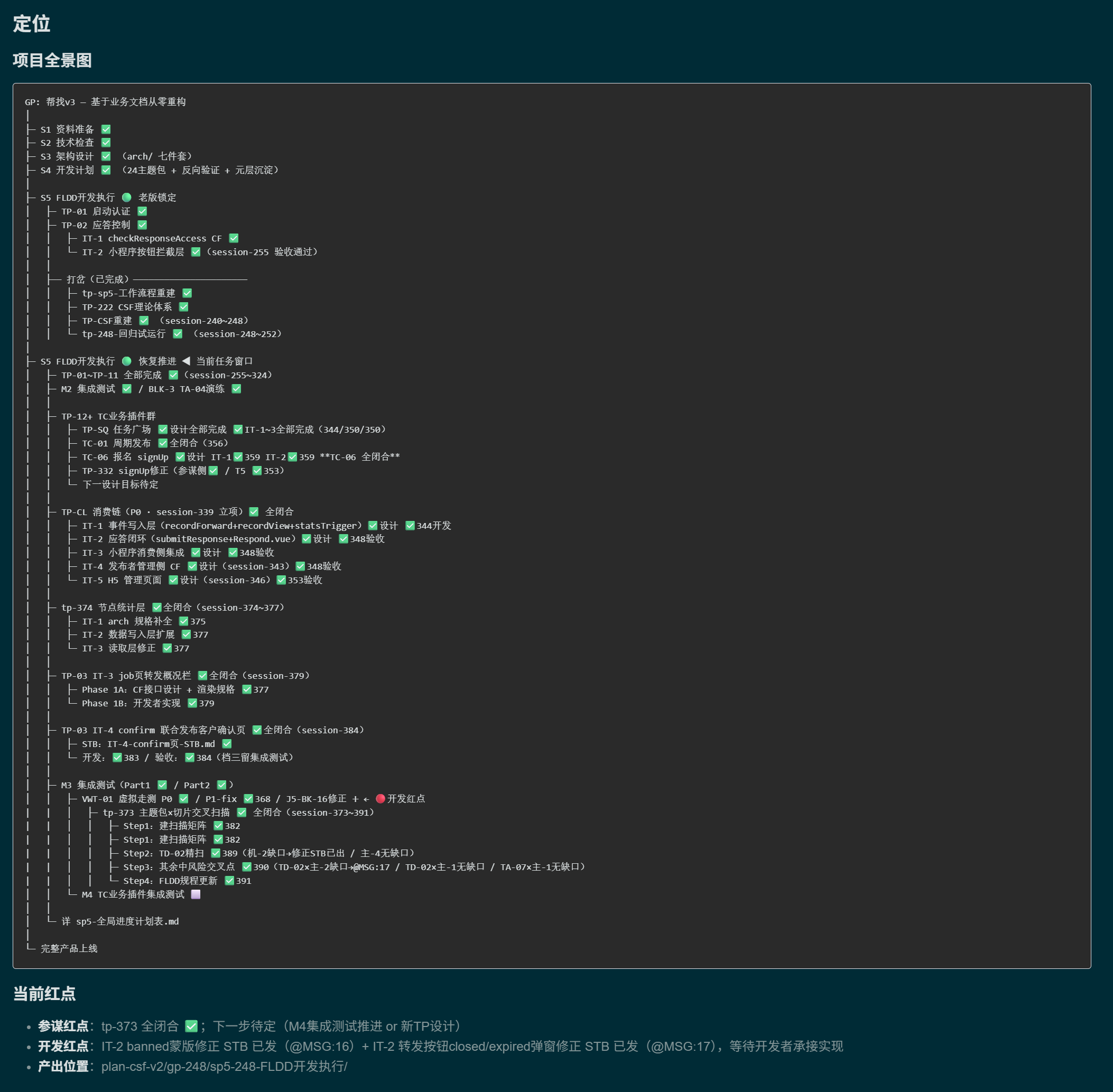
Things to notice while reading it:
- The whole project, from S1 through M4, with multiple side-quests (CSF’s own rebuild, regression dry-run, node-stats layer, the cross-scan matrix…) and multiple replans — and the AI is always aware of where it is, where it came from, and where it has yet to go.
- The three lines under “current red dot” (Chief-of-Staff red dot / Developer red dot / output location) let any new session pick up the work with zero search. That is the engineering payoff of the baseline–log separation plus the trigger index.
- This artifact survived hundreds of sessions, many workdays, many topic-package transitions, and many human–AI handovers — and remains clean, structured, and trustworthy. That is empirical evidence that an AI under the CSF protocol can hold a faithful “project memory” over the long run.
Compared with the industry status quo, very few LLM workflows produce a durable, AI-authored project state that the AI itself can rely on across long horizons, replans, and role rotations. CSF makes this routine.
Theoretical Independence
The six independent contributions form a self-contained body of work that researchers can engage with on its own terms:
- The consumer-side vs supply-side analytic frame
- Purpose-driven attention engineering (not prompt engineering)
- Engineering-layer capability growth decoupled from the model layer (same model + better engineering organization -> better results)
- The filesystem as an extended-cognition substrate (extended cognition)
- The D3 knowledge-routing system
- The business-language amplification mechanism (the W-protocol’s core epistemological insight: cross-language translation amplifies misunderstanding; business intuition is the detector)
If you are a decision-maker or engineering leader struggling with runaway RAG complexity, agent-orchestration cost, or stalled AI engineering adoption — read the Manifesto and csf-minimal, then reach out.
Roadmap
- Minimal teaching pack (csf-minimal)
- Core introductory articles (Chinese introduction + English Manifesto)
- License Selection (CC BY-NC 4.0)
- Complete contact details (CONTACT.md, Bilingual)
- Structured hands-on manual (QUICKSTART.md, Bilingual)
- csf-lite Public intro (csf-lite/README.md)
- Industry cases & community feedback
What Comes Next
I’ll keep answering questions here (GitHub Issues / email) and, when topics deserve it, publish longer column-style essays in this repo for more systematic help. If you have a question, just ask — that is the most natural next step for this work.
Contact
Developed and validated by dapangangang inside a real WeChat Mini-Program commercial project spanning over 395 sessions.
- Chinese speakers: Primarily based in the ZSXQ Paid Community 「一个人走」 (advanced tactics, case sharing). Public feedback via GitHub Issues. Email for commercial inquiries.
- English speakers: Email is the most direct way; GitHub Issues for public discussion.
👉 Full contact details: CONTACT.md
Email: dapangangang@gmail.com
How to Cite
If CSF or “the Pang Principle” has helped you, feel free to copy any citation formats below.
One-line citation (English)
[CSF — The Pang Principle](https://github.com/huidev2025/CSF) — dapangangang, 2026
Full block citation
> “The value of AI comes from its intelligence.
> Trying to make it as reliable as a machine is exactly the act of destroying that value.”
> — The Pang Principle, dapangangang (CSF, 2026)
> https://github.com/huidev2025/CSF
At the end of your project’s context.md (Recommended)
<!-- Built with CSF · https://github.com/huidev2025/CSF -->
License
The textual content of this repository is licensed under CC BY-NC 4.0.
- Personal, academic, non-profit use: free to share and adapt with attribution.
- Commercial use requires permission — please reach out. Paid licensing is not the default.
- Startups: free.
- Unsure whether your use is commercial? Open an issue or email dapangangang@gmail.com.
A Note Beyond the License
Legally, CC BY-NC asks for attribution. What I’d actually love more:
- If you use it, tell me what you’re building — an issue, an email, a social-media @ all work.
- Not a requirement. Just to stay in touch.
- Startups are free; if it ends up helping you, come say hi when you’ve made it.
English inquiries: please read CONTACT.md · dapangangang@gmail.com · GitHub Issues
✍️ A Note on Authorship
Articles in this repo are signed by dapangangang with AI. Two authors, one corresponding author — the AI is, well, famously forgetful :)